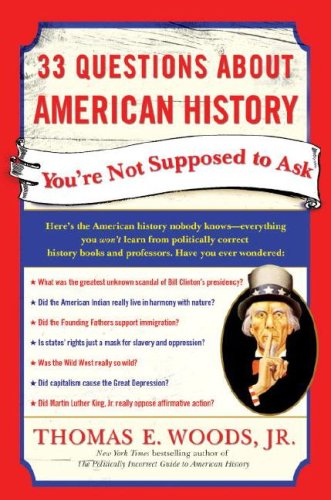
33 Questions About American History You're Not Supposed to Ask

Hardcover - July 10, 2007

By Thomas E. Woods Jr.

ISBN: 0307346684
Publisher: Crown Forum
Year: 2007
Pages: 320

About This Book

Guess what? The Indians didn’t save the Pilgrims from starvation by teaching them to grow corn. Thomas Jefferson thought states’ rights-an idea reviled today-were even more important than the Constitution’s checks and balances. The “Wild” West was more peaceful and a lot safer than most modern cities. And the biggest scandal of the Clinton years didn’t involve an intern in a blue dress. Surprised? Don’t be. In America, where history is riddled with misrepresentations, misunderstandings, and flat-out lies about the people and events that have shaped the nation, there’s the history you know and then there’s the truth. In 33 Questions About American History You’re Not Supposed to Ask, Thomas E. Woods Jr., the New York Times bestselling author of The Politically Incorrect Guide to American History, sets the record straight with a provocative look at the hidden truths about our nation’s history-the ones that have been buried because they’re too politically incorrect to discuss. Woods draws on real scholarship-as opposed to the myths, platitudes, and slogans so many other “history” books are based on-to ask and answer tough questions about American history, including:- Did the Founding Fathers support immigration?- Was the Civil War all about slavery?- Did the Framers really look to the American Indians as the model for the U.S. political system?- Was the U.S. Constitution meant to be a “living, breathing” document-and does it grant the federal government wide latitude to operateas it pleases?- Did Bill Clinton actually stop a genocide, as we’re told?You’d never know it from the history that’s been handed down to us, but the answer to all those questions is no. Woods’s eye-opening exploration reveals how much has been whitewashed from the historical record, overlooked, and skewed beyond recognition. More informative than your last U.S. history class, 33 Questions About American History You’re Not Supposed to Ask will have you wondering just how much about your nation’s past you haven’t been told.

Product Details

Publisher Crown Forum
Publication date January 1, 2007
Language English
Print length 320 pages
ISBN-10 0307346684
ISBN-13 978-0307346681
Item Weight 1.25 pounds

Editorial Reviews

Editorial Review

From BooklistSpread among current events and constitutional law, Woods' 33 questions extend his criticism of liberal viewpoints on American history elaborated in The Politically Incorrect Guide to American History (2004). Ideas that the Constitution is a "living" document, that the New Deal ended the Depression, and that foreign aid alleviates world poverty are some nostrums the author critiques, while others are more populist. Should you heed, for example, historians' rankings of presidents? Perhaps as measurements of the history profession's ideological tilt, avers Woods, who holds that such lists favor big-government presidents and slight little-government types such as Cleveland and Coolidge. Woods is also concerned that the concept of states rights is viewed negatively, so several questions probe its con-law pedigree and the assertion that it, more than slavery, is what the South fought for in the Civil War. Alighting rather disconnectedly on "the biggest unknown scandal of the Clinton years," George Washington Carver's scientific significance, and Social Security, Woods is at least consistent in maintaining that Americans' historical awareness is befogged by myths. Marketed through conservative media, the assertive Woods will generate requests. Taylor, GilbertAbout the AuthorThomas E. Woods jr. is the New York Times bestselling author of The Politically Incorrect Guide to American History and How the Catholic Church Built Western Civilization. He holds a B.A. in history from Harvard and an M.A., an M.Phil., and a Ph.D. from Columbia University. A contributing editor of The American Conservative magazine, Woods has received the Templeton Enterprise Award, the O. P. Alford III Prize for Libertarian Scholarship, and an Olive W. Garvey Fellowship from the Independent Institute. He and his family live in Alabama, where he is a fellow at the Ludwig von Mises Institute. Excerpt. © Reprinted by permission. All rights reserved. QUESTION1Did the Founding Fathers Support Immigration?Though polls consistently find that a majority of Americans believe immigration levels need to be reduced, many people still assume that the right of immigration is a hallowed American principle that no loyal citizen can consistently oppose.This assumption is false.Actually, the Founding Fathers were generally wary of immigration. They did not wish to exclude it altogether, but they saw no particular need to encourage it, especially among migrants whose cultural backgrounds were significantly different from their own.Consider Benjamin Franklin, that well-known cosmopolite and child of the Enlightenment. Franklin, it turns out, said quite a few politically incorrect things about non-British humanity (a category that includes the present writer). On one occasion he asked, "Why should Pennsylvania, founded by the English, become a colony of aliens, who will shortly be so numerous as to Germanize us, instead of our Anglifying them, and will never adopt our language or customs
Shipping set per seller
Compare book + shipping totals for each offer
Seller-error returns
Returns accepted for seller errors. Ask the seller about change-of-mind returns
Partner purchases
MedicalBook.online handles payment, shipping and returns for its orders
Email Support
[email protected] for buyers and sellers