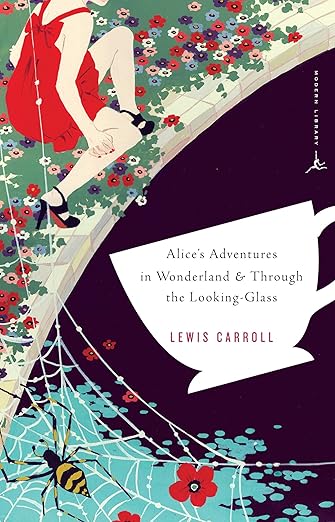
Review“Only Lewis Carroll has shown us the world upside down as a child sees it, and has made us laugh as children laugh.” -Virginia WoolfFrom the Back CoverConceived by a shy British don on a golden afternoon to entertain ten-year-old Alice Liddell and her sisters, "Alice's Adventures in Wonderland and "Through the Looking-Glass have delighted generations of readers in more than eighty languages. "The clue to the enduring fascination and greatness of the "Alice books," writes A. S. Byatt in her Introduction, "lies in language. . . . It is play, and word-play, and its endless intriguing puzzles continue to reveal themselves long after we have ceased to be children." About the Author “Lewis Carroll,” creator of the brilliantly witty Alice’s Adventures in Wonderland, was a pseudonym for Charles Lutwidge Dodgson, a shy Oxford don with a stammer.He was born at Daresbury, Cheshire on January 27, 1832, son of a vicar. As the eldest boy among eleven children, he learned early to amuse his siblings by writing and editing family magazines. He was educated at Christ Church College, Oxford, where he lectured in mathematics from1855 to 1881. In 1861 he was ordained as a deacon.Dodgson’s entry into the world of fiction was accidental. It happened one “golden afternoon” as he escorted his colleague’s three daughters on a trip up the river Isis. There he invented the story that might have been forgotten if not for the persistence of the youngest girl, Alice Liddell. Thanks to her, and to her encouraging friends, Alice was published in 1865, with drawings by the political cartoonist, John Tenniel. After Alice, Dodgson wrote Phantasmagoria and Other Poems (1869), Through the Looking-Glass (1871), The Hunting of Shark (1876, and Rhyme? and Reason? (1883).As a mathematician Dodgson is best known for Euclid and His Modern Rivals (1879). He was also a superb children’s photographer, who captured the delicate, sensuous beauty of such little girls as Alice Liddell and Ellen Terry, the future actress. W.H. Auden called him “one of the best portrait photographer of the century.” Dodgson was also an inventor; his projects included a game of arithmetic croquet, a substitute for glue, and an apparatus for making notes in the dark. Though he sought publication for his light verse, he never dreamed his true gift-telling stories to children-merited publication or lasting fame, and he avoided publicity scrupulously Charles Dodgson died in 1898 of influenza. Excerpt. © Reprinted by permission. All rights reserved. CHAPTER IDown the Rabbit-HoleAlice was beginning to get very tired of sitting by her sister on the bank, and of having nothing to do: once or twice she had peeped into the book her sister was reading, but it had no pictures or conversations in it, "and what is the use of a book," thought Alice, "without pictures or conversations?"So she was considering in her own mind (as well as she could, for the hot day made her feel very sleepy and st