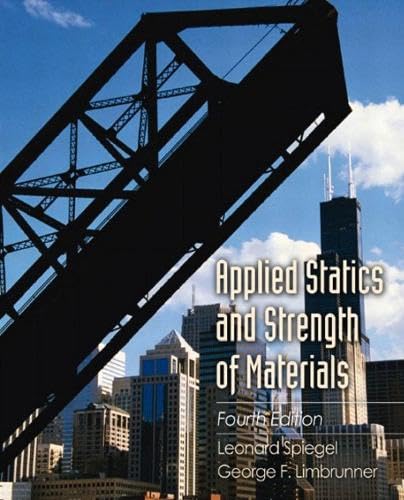
From the Back CoverFocusing on the fundamentals of material statics and strength, this book presents a non-Calculus-based, elementary, analytical, and practical approach, with example problems that follow the explanation of theory. The object of the book is to provide users with the necessary mechanics background to relate to the many fields of engineering technologye.g., civil, mechanical, construction, architectural, industrial, and manufacturing. This comprehensive book covers the fundamentals of statics, coplanar force systems, structures, friction, gravity, inertia, stresses, properties of materials, torsion, shear and bending, beams, columns, connections, and pressure vessels. For use as a reference work for civil engineers, mechanical engineers, construction engineers, architects, industrial engineers, and manufacturing engineers.Excerpt. © Reprinted by permission. All rights reserved. The fourth edition of Applied Statics and Strength of Materials presents an elementary, analytical, and practical approach to the principles and physical concepts of statics and strength of materials. It is written at an appropriate mathematics level for engineering technology students, using algebra, trigonometry, and analytic geometry. A knowledge of calculus is not required for understanding the text or for working the problems. The fourth edition of Applied Statics and Strength of Materials presents an elementary, analytical, and practical approach to the principles and physical concepts of statics and strength of materials. It is written at an appropriate mathematics level for engineering technology students, using algebra, trigonometry, and analytic geometry. A knowledge of calculus is not required for understanding the text or for working the problems. The book is intended primarily for use in two-year or four-year technology programs in engineering, construction, or architecture. Much of the material has been classroom tested in our Accreditation Board for Engineering and Technology (ABET) accredited engineering technology programs as well as in our American Council for Construction Education (ACCE) accredited construction technology program. The text can also serve as a concise reference guide for undergraduates in a first Engineering Mechanics (Statics) and/or Strength of Materials course in engineering programs. Although written primarily for the technology student, it could also serve as a valuable guide for practicing technologists and technicians as well as for those preparing for state licensing exams for professional registration in engineering, architecture, or construction. The book is intended primarily for use in two-year or four-year technology programs in engineering, construction, or architecture. Much of the material has been classroom tested in our Accreditation Board for Engineering and Technology (ABET) accredited engineering technology programs as well as in our American Council for Construction Education (ACCE) accredited cons