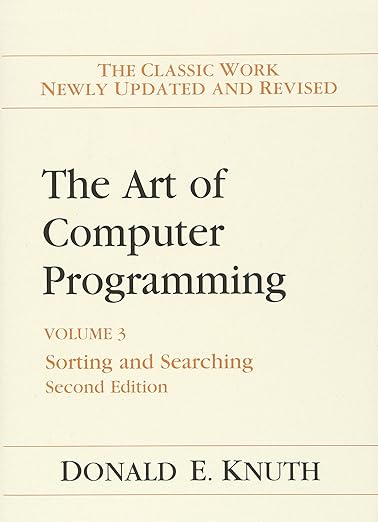
Art of Computer Programming

2nd Edition

By Donald Knuth

ISBN: 0201896850
Publisher: Addison-Wesley Professional
Year: 2007
Pages: 800

About This Book

The bible of all fundamental algorithms and the work that taught many of today's software developers most of what they know about computer programming.-Byte, September 1995I can't begin to tell you how many pleasurable hours of study and recreation they have afforded me! I have pored over them in cars, restaurants, at work, at home... and even at a Little League game when my son wasn't in the line-up.-Charles LongIf you think you're a really good programmer... read [Knuth's] Art of Computer Programming... You should definitely send me a resume if you can read the whole thing.-Bill GatesIt's always a pleasure when a problem is hard enough that you have to get the Knuths off the shelf. I find that merely opening one has a very useful terrorizing effect on computers.-Jonathan LaventholThe first revision of this third volume is the most comprehensive survey of classical computer techniques for sorting and searching. It extends the treatment of data structures in Volume 1 to consider both large and small databases and internal and external memories. The book contains a selection of carefully checked computer methods, with a quantitative analysis of their efficiency. Outstanding features of the second edition include a revised section on optimum sorting and new discussions of the theory of permutations and of universal hashing.

Product Details

Publisher Addison-Wesley Professional
Publication date January 1, 2007
Language English
Print length 800 pages
ISBN-10 0201896850
ISBN-13 978-0201896855
Item Weight 2.9 pounds

Editorial Reviews

Editorial Review

From the Inside FlapCookery is become an art, a noble science; cooks are gentlemen. TITUS LIVIUS, Ab Urbe Condita XXXIX.vi (Robert Burton, Anatomy of Melancholy 1.2.2.2)This book forms a natural sequel to the material on information structures in Chapter 2 of Volume 1, because it adds the concept of linearly ordered data to the other basic structural ideas. This book forms a natural sequel to the material on information structures in Chapter 2 of Volume 1, because it adds the concept of linearly ordered data to the other basic structural ideas. The title "Sorting and Searching" may sound as if this book is only for those systems programmers who are concerned with the preparation of general-purpose sorting routines or applications to information retrieval. But in fact the area of sorting and searching provides an ideal framework for discussing a wide variety of important general issues:The title "Sorting and Searching" may sound as if this book is only for those systems programmers who are concerned with the preparation of general-purpose sorting routines or applications to information retrieval. But in fact the area of sorting and searching provides an ideal framework for discussing a wide variety of important general issues:How are good algorithms discovered? How can given algorithms and programs be improved? How can the efficiency of algorithms be analyzed mathematically? How can a person choose rationally between different algorithms for the same task? In what senses can algorithms be proved ''best possible''? How does the theory of computing interact with practical considerations? How can external memories like tapes, drums, or disks be used efficiently with large databases? How are good algorithms discovered? How can given algorithms and programs be improved? How can the efficiency of algorithms be analyzed mathematically? How can a person choose rationally between different algorithms for the same task? In what senses can algorithms be proved ''best possible''? How does the theory of computing interact with practical considerations? How can external memories like tapes, drums, or disks be used efficiently with large databases? Indeed, I believe that virtually every important aspect of programming arises somewhere in the context of sorting or searching! Indeed, I believe that virtually every important aspect of programming arises somewhere in the context of sorting or searching! This volume comprises Chapters 5 and 6 of the complete series. Chapter 5 is concerned with sorting into order; this is a large subject that has been divided chiefly into two parts, internal sorting and external sorting. There also are supplementary sections, which develop auxiliary theories about permutations (Section 5.1) and about optimum techniques for sorting (Section 5.3). Chapter 6 deals with the problem of searching for specified items in tables or files; this is subdivided into methods that search sequentially, or by comparison of keys, or by digital properti
Shipping set per seller
Compare book + shipping totals for each offer
Seller-error returns
Returns accepted for seller errors. Ask the seller about change-of-mind returns
Partner purchases
MedicalBook.online handles payment, shipping and returns for its orders
Email Support
[email protected] for buyers and sellers