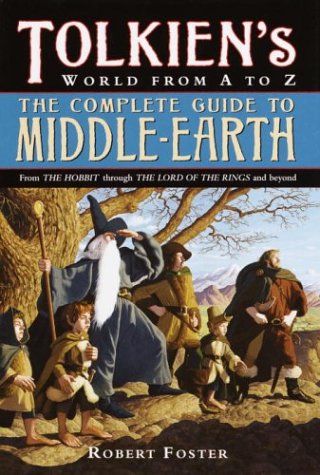
From the Inside FlapFor the millions who have already ventured to Middle-earth, and for the countless others who have yet to embark on the journey?here is the one indispensable A-to-Z guide that brings Tolkien?s universe to life.EVERY CHARACTERFrom Adaldrida Brandybuck to Zaragamba?every Hobbit, Elf, Dwarf, Man, Orc, or other resident of Middle-earth is vividly described and accurately located in proper place and time.EVERY PLACEColorfully detailed descriptions of geographical entries allow you to pick up the action anywhere in Middle-earth and follow it through all five volumes.EVERY THINGFrom stars and streams to food and flora, everything found in Middle-earth is alphabetically listed and, when necessary, cross-referenced.HERE IS TRULY A MASTER KEYTO TOLKIEN?S MIDDLE-EARTHFrom the Trade Paperback edition.About the AuthorJohn Ronald Reuel Tolkien was born on January 3, 1892, in Bloemfontein, South Africa. After serving in the First World War, he embarked upon a distinguished academic career and was recognized as one of the finest philologists in the world. He was a professor of Anglo-Saxon at Oxford, a fellow of Pembroke College, and a fellow of Merton College until his retirement in 1959. He is, however, beloved throughout the world as the creator of Middle-earth and author of such classic works as The Hobbit and The Lord of the Rings. He died on September 2, 1973, at the age of 81.From the Trade Paperback edition. Excerpt. © Reprinted by permission. All rights reserved. With the appearance of The Silmarillion, the publication ofJ. R. R. Tolkien's mythopoesis is virtually complete. Thereader can now appreciate the full scope and significance of thehistory of Aman and Middle-earth, the central stages in the greatdrama of the Creation of Eae. One can trace in detail the Light ofAman from the Two Trees on Ezellohar to the renewing power ofthe Phial of Galadriel in the stinking darkness of Shelob's Lair.The terror felt there by Sam Gamgee is better understood afterreading of the Unlight of Ungoliant, and Boromir's desire for theRing can be seen as a wisp of the Shadow of Melkor, who lustedafter Light but created only Darkness. Not only do the great conflictsbetween East and West--from the First War and the Battle ofthe Powers to the Battle of Fornost and the War of the Ring--reveal the nature of good and evil and the immeasurable compassionof Iluvatar, but also, the identity of the forces that interveneto give victory to the good suggests the progressive freeing of Manfrom the influence of both Valar and demons to work out his owndestiny, known to Iluvatar alone.Writing this revised edition of my Guide to Middle-earth hasenhanced my awareness of these correspondences, designs whichare surely central to the joy of Faerie and which give ProfessorTolkien's work its marvelous and profound coherence. But it hasalso made me aware of the difference between the conception andthe realization of this cycle of myth and romance, between the'visionary scene'