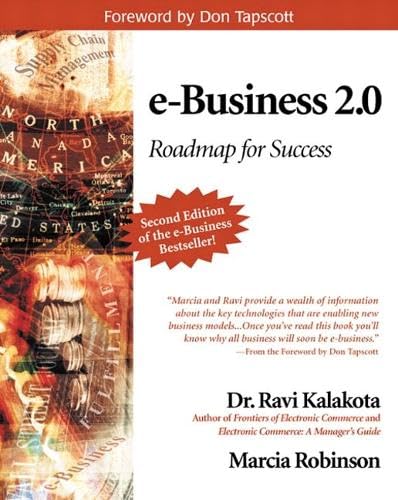
Amazon.com ReviewIn e-Business 2.0, Ravi Kalakota and Marcia Robinson present a survey of how the processes of business have changed as a result of computer-assisted communications, data storage, and data analysis. They explain recent technological advances--and those that may take place in the near and middle future--and explain how companies that sell products and services might put them to profitable use. With an emphasis on companies that sell things to large numbers of consumers, the authors argue convincingly that information technology isn't an end in itself, but a tool that can facilitate valuable changes in business processes. This is a book for managers and organizational planners, but it commits none of the sins typical of such books. It neither oversimplifies technical matters nor serves as a mere platform for catchy phrases and obtuse illustrations. e-Business 2.0 is properly focused on the big technologies on which successful companies will capitalize. Kalakota and Robinson argue that it's a good idea to supplement live salespeople with self-service sales facilities, such as those on a Web site. They call this a part of selling-chain management. This is a book for managers and organizational planners, but it commits none of the sins typical of such books. It neither oversimplifies technical matters nor serves as a mere platform for catchy phrases and obtuse illustrations. e-Business 2.0 is properly focused on the big technologies on which successful companies will capitalize. Kalakota and Robinson argue that it's a good idea to supplement live salespeople with self-service sales facilities, such as those on a Web site. They call this a part of selling-chain management. The authors also explain how inefficiencies in the selling chain can make it prohibitively expensive to provide built-to-order products, which consumers increasingly want. They then present solutions: Internet and customer relationship management (IRM and CRM) software, sales automation systems, and proposal-automation tools. In each case, they cite specific examples (usually companies and products), enabling readers to dig deeper into specifics if they want. Similar attention goes to enterprise resource planning (ERP), trend-spotting tools, and half a dozen other technologies. Read this guide as you think about how to make strategic changes in your company's operating practices. --David Wall The authors also explain how inefficiencies in the selling chain can make it prohibitively expensive to provide built-to-order products, which consumers increasingly want. They then present solutions: Internet and customer relationship management (IRM and CRM) software, sales automation systems, and proposal-automation tools. In each case, they cite specific examples (usually companies and products), enabling readers to dig deeper into specifics if they want. Similar attention goes to enterprise resource planning (ERP), trend-spotting tools, and half a dozen other technologies. R