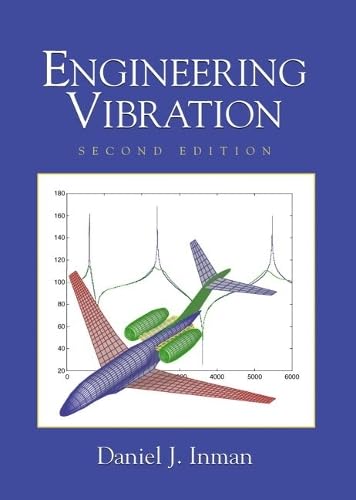
From the Back CoverThis text presents material common to a first course in vibration and the integration of computational software packages into the development of the text material (specifically makes use of MATLAB, MathCAD, and Mathematica). This allows solution of difficult problems, provides training in the use of codes commonly used in industry, encourages students to experiment with equations of vibration by allowing easy "what if" solutions. This also allows students to make precision response plots, computation of frequencies, damping ratios, and mode shapes. This encourages students to learn vibration in an interactive way, to solidify the design components of vibration and to integrate nonlinear vibration problems earlier in the text. The text explicitly addresses design by grouping design related topics into a single chapter and using optimization, and it connects the computation of natural frequencies and mode shapes to the standard eigenvalue problem, providing efficient and expert computation of the modal properties of a system. In addition, the text covers modal testing methods, which are typically not discussed in competing texts.This text presents material common to a first course in vibration and the integration of computational software packages into the development of the text material (specifically makes use of MATLAB, MathCAD, and Mathematica). This allows solution of difficult problems, provides training in the use of codes commonly used in industry, encourages students to experiment with equations of vibration by allowing easy "what if" solutions. This also allows students to make precision response plots, computation of frequencies, damping ratios, and mode shapes. This encourages students to learn vibration in an interactive way, to solidify the design components of vibration and to integrate nonlinear vibration problems earlier in the text. The text explicitly addresses design by grouping design related topics into a single chapter and using optimization, and it connects the computation of natural frequencies and mode shapes to the standard eigenvalue problem, providing efficient and expert computation of the modal properties of a system. In addition, the text covers modal testing methods, which are typically not discussed in competing texts.Highlights of the Second EditionHighlights of the Second EditionIntegration of computational software to include Mathematica and MathCAD as well as MATLAB in each chapter, updated Engineering Vibration Toolbox and web site.Integration of computational software to include Mathematica and MathCAD as well as MATLAB in each chapter, updated Engineering Vibration Toolbox and web site.Integration of the numerical simulation and computing into each topic by chapterIntegration of the numerical simulation and computing into each topic by chapterNonlinear considerations added at the end of each early chapter through simulationNonlinear considerations added at the end of each early chapter thr