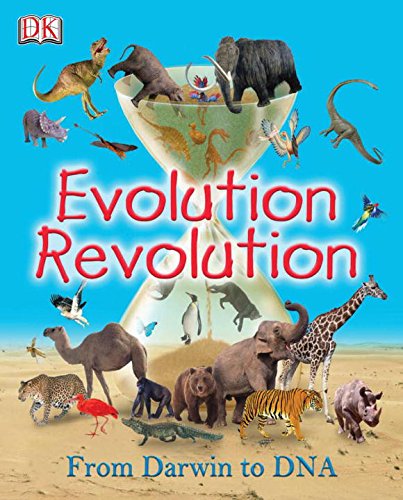
From School Library JournalGrade 4-8-Sidebars and photos dominate this highly visual survey. The first two thirds of the book are devoted to the history of thought and research on evolution, from stories of Creation, through Darwin, to genetics. The last third looks at "Evolution in Action." Information on the fetuses of related species rubs shoulders with variations within species and a time line of the Earth. Visually, the book snaps with colored backgrounds, cool graphics, topflight photos, and clever word balloons coming from vintage black-and-white reproductions. Suggested activities are worth trying, and a guessing game on related species does a fine job of enhancing understanding of the concept of evolutionary lines. Browsers will enjoy dipping in and out, but the book reads surprisingly well straight through, and readers who devour it whole will learn a great deal.-Ellen Heath, Easton Area Public Library, Easton, PA Copyright © Reed Business Information, a division of Reed Elsevier Inc. All rights reserved.From Booklist*Starred Review* Dense with exciting scientific detail, this large picture-book-size volume focuses in its first half on Darwin’s discoveries and theories, and the excitement and the controversy that they generated in his time. Then biologist Winston goes on to discuss the modern science of genetics and evolutionary biology, including what Darwin did not consider and what he knew little about; the many new discoveries that prove Darwin right and that continue to fuel debate; and the role of DNA in helping to fill in the gaps. The clear, interactive, double-page spreads in the publisher’s signature style pack in a wealth of very technical information with lots of gorgeous color photos, screens, and boxed inserts. Also included is a detailed six-page time line of the planet over four million years. Readers can browse through and delve into the geology and biology facts that grab them, and then follow some of the “Now try this!” suggestions, such as “How to find out what was living in your neighborhood 250,000 years ago.” As accessible as it is informative, this is a great title for classroom browsing and sharing. Grades 5-8. --Hazel Rochman Review With big, bold collages comprised of photographs, shifting text sizes and fonts, and all manner of quirky scientific presentations, this is a very compelling look at Darwin, the work of other naturalists and their work. . Winston discusses why some animals are born with reduced pigment and how similar animals evolve differently in different locations. Subjects as diverse as Gregor Mendel s pea plant experiments to the evolution of bee colonies is explored on vividly colored double-page spreads that draw the reader in with irresistible graphics and slowly, unpretentiously, lead the curious along a grand scientific story. DK continues to impress me with their 21st century design that has transformed the encyclopedia format. Winston is a perfect partner for this