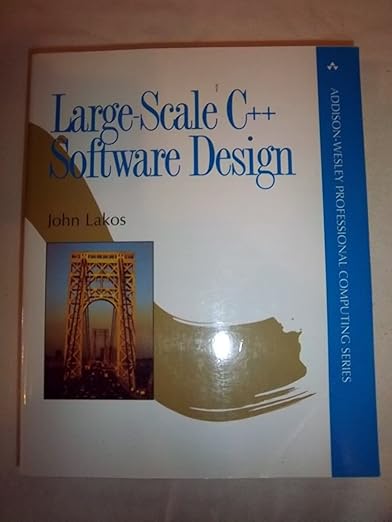
Large-scale C++ software design

1st Edition

By John Lakos

ISBN: 0201633620
Publisher: Addison-Wesley
Year: 1996
Pages: 896

About This Book

include a dimension with which even expert software developers may have little or no experience. This is the definitive book for all C++ software professionals involved in large development efforts such as databases, operating systems, compilers, and frameworks. It is the first C++ book that actually demonstrates how to design large systems, and one of the few books on object-oriented design specifically geared to practical aspects of the C++ programming language. In this book, Lakos explains the process of decomposing large systems into physical (not inheritance) hierarchies of smaller, more manageable components. Such systems with their acyclic physical dependencies are fundamentally easier and more economical to maintain, test, and reuse than tightly interdependent systems. In addition to explaining the motivation for following good physical as well as logical design practices, Lakos provides you with a catalog of specific techniques designed to eliminate cyclic, compile-time, and link-time (physical) dependencies. He then extends these concepts from large to very large systems. The book concludes with a comprehensive top-down approach to the logical design of individual components. Appendices include a valuable design pattern ""Protocol Hierarchy"" designed to avoid fat interfaces while minimizing physical dependencies; the details of implementing an ANSI C compatible C++ procedural interface; and a complete specification for a suite of UNIX-like tools to extract and analyze physical dependencies. Practical design rules, guidelines, and principles are also collected in an appendix and indexed for quick reference.

Product Details

Publisher Addison-Wesley
Publication date January 1, 1996
Language English
Print length 896 pages
ISBN-10 0201633620
ISBN-13 978-0201633627
Item Weight 0.46 pounds

Editorial Reviews

Editorial Review

From the Inside FlapAs a member of the IC Division at Mentor Graphics Corporation, I am fortunate to have worked with many bright, talented software engineers, developing very large systems. Back in 1985, Mentor Graphics became one of the first companies to attempt a truly large project in C++. Back then no one knew how to do that, and no one could have anticipated the cost overruns, slipped schedules, huge executables, poor performance, and incredibly expensive build times that a naive approach would inevitably produce. Back in 1985, Mentor Graphics became one of the first companies to attempt a truly large project in C++. Back then no one knew how to do that, and no one could have anticipated the cost overruns, slipped schedules, huge executables, poor performance, and incredibly expensive build times that a naive approach would inevitably produce. Many valuable lessons were learned along the way - knowledge obtained through bitter experience. There were no books to help guide the design process; object-oriented designs on this scale had never before been attempted. Many valuable lessons were learned along the way - knowledge obtained through bitter experience. There were no books to help guide the design process; object-oriented designs on this scale had never before been attempted. Ten years later, with a wealth of valuable experience under its belt, Mentor Graphics has produced several large software systems written in C++, and in doing so has paved the way for others to do the same without having to pay such a high price for the privilege. Ten years later, with a wealth of valuable experience under its belt, Mentor Graphics has produced several large software systems written in C++, and in doing so has paved the way for others to do the same without having to pay such a high price for the privilege. During my 13 years as a C (turned C++) Computer-Aided Design (CAD) software developer, I have seen over and over again that planning ahead invariably produces a higher-quality, more maintainable product. My emphasis at Mentor Graphics has been on helping to ensure that quality is an integral part of the design process from the very start. During my 13 years as a C (turned C++) Computer-Aided Design (CAD) software developer, I have seen over and over again that planning ahead invariably produces a higher-quality, more maintainable product. My emphasis at Mentor Graphics has been on helping to ensure that quality is an integral part of the design process from the very start. In 1990 I developed the graduate course "Object-Oriented Design and Programming" at Columbia University. As the instructor of this course since 1991, I have had the opportunity to share many of the insights that we at Mentor Graphics gained during our industrial-strength software development efforts. Questions and feedback from literally hundreds of graduate students and professional programmers have helped me to crystallize many important concepts. This book is a direct resul
Shipping set per seller
Compare book + shipping totals for each offer
Seller-error returns
Returns accepted for seller errors. Ask the seller about change-of-mind returns
Partner purchases
MedicalBook.online handles payment, shipping and returns for its orders
Email Support
[email protected] for buyers and sellers