Books

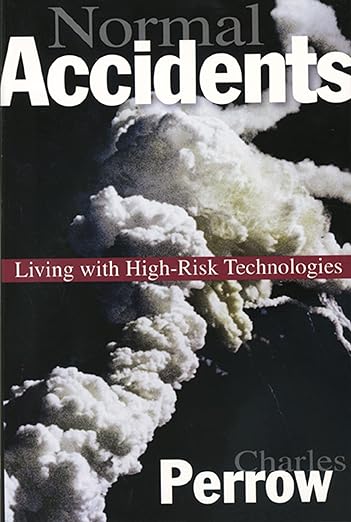
Normal accidents

Updated Edition

By Charles Perrow

ISBN: 0691004129
Publisher: Princeton University Press
Year: 1999
Pages: 464
Compare & Save from $52.14 total - 3 sellers competing

Select Condition

Condition Guide

Select a condition to see available offers

About This Book

Normal Accidents analyzes the social side of technological risk. Charles Perrow argues that the conventional engineering approach to ensuring safety--building in more warnings and safeguards--fails because systems complexity makes failures inevitable. He asserts that typical precautions, by adding to complexity, may help create new categories of accidents. (At Chernobyl, tests of a new safety system helped produce the meltdown and subsequent fire.) By recognizing two dimensions of risk--complex versus linear interactions, and tight versus loose coupling--this book provides a powerful framework for analyzing risks and the organizations that insist we run them. The first edition fulfilled one reviewer's prediction that it "may mark the beginning of accident research." In the new afterword to this edition Perrow reviews the extensive work on the major accidents of the last fifteen years, including Bhopal, Chernobyl, and the Challenger disaster. The new postscript probes what the author considers to be the "quintessential 'Normal Accident'" of our time: the Y2K computer problem.
Marketplace from $52.14
Partner price may differ
Buy →

Product Details

Publisher Princeton University Press
Publication date January 1, 1999
Language English
Print length 464 pages
ISBN-10 0691004129
ISBN-13 978-0691004129
Item Weight 1.38 pounds

All Marketplace Offers

3 sellers competing for your order

Filter:
Condition Seller Total (book + shipping) Delivery Action
Acceptable

Shipping standard: ships in ≤2 business days · Returns: Ask seller before buying · Seller-error returns always accepted (30 days; seller covers return shipping).

ZO
New seller · 0 reviews
$52.14
$49.15 book + $2.99 shipping
Arrives Nov 26-Nov 29 · Handling: 2 days
Estimated · shipping & returns
Select
Very Good

Shipping standard: ships in ≤2 business days · Returns: Ask seller before buying · Seller-error returns always accepted (30 days; seller covers return shipping).

SC
New seller · 0 reviews
$123.23
$123.23 book + $0.00 shipping
Arrives Nov 29-Dec 2 · Handling: 5 days
Estimated · shipping & returns
Select
Like New

Shipping standard: ships in ≤2 business days · Returns: Ask seller before buying · Seller-error returns always accepted (30 days; seller covers return shipping).

A
New seller · 0 reviews
$123.63
$117.64 book + $5.99 shipping
Arrives Nov 27-Nov 30 · Handling: 3 days
Estimated · shipping & returns
Select
No marketplace copies available in this condition.
Showing of 3 offers

Editorial Reviews

Editorial Review

Amazon.com ReviewHang a curtain too close to a fireplace and you run the risk of setting your house ablaze. Drive a car on a pitch-black night without headlights, and you dramatically increase the odds of smacking into a tree. These are matters of common sense, applied to simple questions of cause and effect. But what happens, asks systems-behavior expert Charles Perrow, when common sense runs up against the complex systems, electrical and mechanical, with which we have surrounded ourselves? Plenty of mayhem can ensue, he replies. The Chernobyl nuclear accident, to name one recent disaster, was partially brought about by the failure of a safety system that was being brought on line, a failure that touched off an unforeseeable and irreversible chain of disruptions; the less severe but still frightening accident at Three Mile Island, similarly, came about as the result of small errors that, taken by themselves, were insignificant, but that snowballed to near-catastrophic result. These are matters of common sense, applied to simple questions of cause and effect. But what happens, asks systems-behavior expert Charles Perrow, when common sense runs up against the complex systems, electrical and mechanical, with which we have surrounded ourselves? Plenty of mayhem can ensue, he replies. The Chernobyl nuclear accident, to name one recent disaster, was partially brought about by the failure of a safety system that was being brought on line, a failure that touched off an unforeseeable and irreversible chain of disruptions; the less severe but still frightening accident at Three Mile Island, similarly, came about as the result of small errors that, taken by themselves, were insignificant, but that snowballed to near-catastrophic result. Only through such failures, Perrow suggests, can designers improve the safety of complex systems. But, he adds, those improvements may introduce new opportunities for disaster. Looking at an array of real and potential technological mishaps--including the Bhopal chemical-plant accident of 1984, the Challenger explosion of 1986, and the possible disruptions of Y2K and genetic engineering--Perrow concludes that as our technologies become more complex, the odds of tragic results increase. His treatise makes for sobering and provocative reading. --Gregory McNamee Only through such failures, Perrow suggests, can designers improve the safety of complex systems. But, he adds, those improvements may introduce new opportunities for disaster. Looking at an array of real and potential technological mishaps--including the Bhopal chemical-plant accident of 1984, the Challenger explosion of 1986, and the possible disruptions of Y2K and genetic engineering--Perrow concludes that as our technologies become more complex, the odds of tragic results increase. His treatise makes for sobering and provocative reading. --Gregory McNameeReview"[Normal Accidents is] a penetrating study of catastrophes and near catastrophes in several high-risk indu
Shipping set per seller
Compare book + shipping totals for each offer
Seller-error returns
Returns accepted for seller errors. Ask the seller about change-of-mind returns
Partner purchases
MedicalBook.online handles payment, shipping and returns for its orders
Email Support
[email protected] for buyers and sellers