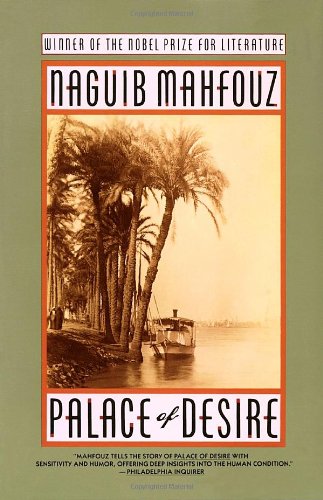
Review“Mahfouz tells the story of Palace of Desire with sensitivity and humor, offering deep insights into the human condition.” -Philadelphia Inquirer “All the magic, mystery, and suffering of Egypt in the 1920s are conveyed on a human scale.” -The New York Times Book Review“A grand novel of ideas. . . . A marvelous read.” -The Washington Post “In Palace of Desire we see the intricate and complex tragedy of patriarchy working itself out through succeeding generations.” -Chicago TribuneFrom the PublisherThe second volume of the highly acclaimed Cairo Trilogy from the winner of the Nobel Prize for Literature. Filled with compelling drama, earthy humor, and remarkable insight, Palace Of Desire is the unforgettable story of the violent clash between ideals and realities, dreams and desires. From the Inside Flap The second volume of the highly acclaimed Cairo Trilogy from the winner of the Nobel Prize for Literature. Filled with compelling drama, earthy humor, and remarkable insight, Palace Of Desire is the unforgettable story of the violent clash between ideals and realities, dreams and desires. About the Author Naguib Mahfouz was born in Cairo in 1911 and began writing when he was seventeen. A student of philosophy and an avid reader, his works range from reimaginings of ancient myths to subtle commentaries on contemporary Egyptian politics and culture. Over a career that lasted more than five decades, he wrote 33 novels, 13 short story anthologies, numerous plays, and 30 screenplays. Of his many works, most famous is The Cairo Trilogy, consisting of Palace Walk (1956), Palace of Desire (1957), and Sugar Street (1957), which focuses on a Cairo family through three generations, from 1917 until 1952. In 1988, he was awarded the Nobel Prize in Literature, the first writer in Arabic to do so. He died in August 2006. Excerpt. © Reprinted by permission. All rights reserved. 1AL-SAYYID AHMAD Abd al-Jawad closed the door behind him and crossed the courtyard of his house by the pale light of the stars. His step was lethargic, and his walking stick sank into the dusty earth whenever he leaned on it wearily. He felt on fire and craved cold water so he could wash his face, head, and neck and escape, if only briefly, from the July heat and from the inferno in his belly and head. Cheered by the thought of cool water, he smiled. When he entered the door leading to the stairway, he could see a faint light coming from above. It flowed along the wall, revealing the motion of the hand that held the lamp. He climbed the steps with one hand on the railing and the other on his stick. Its successive taps had long ago acquired a special rhythm, which identified him as easily as his features. Amina was visible at the head of the stairs with the lamp in her hand. On reaching her, he stopped to regain his breath, for his chest was heaving. Then he greeted her in his customary way: "Good evening."Preceding him with the lamp, Amina murmured, "Good