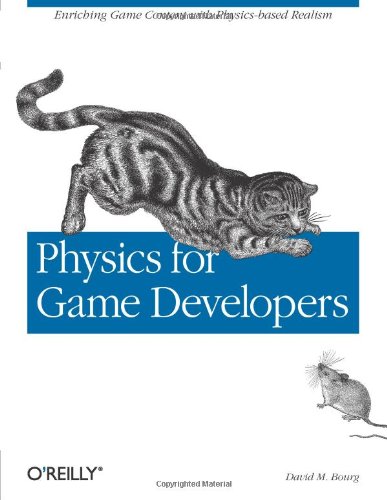
Amazon.com ReviewAimed at the game developer or student/hobbyist interested in physics, Physics for Game Developers reviews all the math for creating realistic motion and collisions for cars, airplanes, boats, projectiles, and other objects along with C/C++ code for Windows. While this authoritative guide isn't for the math-averse, the author's clear presentation and obvious enthusiasm for his subject help make this book a compelling choice for anyone faced with adding realistic motion to computer games or simulations. It's the clear, mathematical presentation here that makes this title a winner. Starting with the basics of Newtonian mechanics, the author covers all the basic equations needed to understand velocity, acceleration, kinematics, and kinetics, among other concepts. A knowledge of college math (including calculus) is assumed. (Appendices review the basics of matrix and quaternion mathematics for those needing a refresher.) It's the clear, mathematical presentation here that makes this title a winner. Starting with the basics of Newtonian mechanics, the author covers all the basic equations needed to understand velocity, acceleration, kinematics, and kinetics, among other concepts. A knowledge of college math (including calculus) is assumed. (Appendices review the basics of matrix and quaternion mathematics for those needing a refresher.) Central to this book is its presentation of modeling projectiles, airplanes, ships, and cars. The author first presents essential mathematical concepts for each kind of object (for instance, pitch, yaw and roll, and lift for airplanes; modeling fluid drag for ships; and braking behavior for cars). For many chapters, Bourg then presents Windows-based DirectX programs in C++ to illustrate key concepts. For example, you can experiment with different parameters to view a cannonball's path. (On their own, these programs make this book a great companion text to any advanced high school or college physics course since students can see the effect of each variable on the behavior of each body in motion for a variety of equations.) Central to this book is its presentation of modeling projectiles, airplanes, ships, and cars. The author first presents essential mathematical concepts for each kind of object (for instance, pitch, yaw and roll, and lift for airplanes; modeling fluid drag for ships; and braking behavior for cars). For many chapters, Bourg then presents Windows-based DirectX programs in C++ to illustrate key concepts. For example, you can experiment with different parameters to view a cannonball's path. (On their own, these programs make this book a great companion text to any advanced high school or college physics course since students can see the effect of each variable on the behavior of each body in motion for a variety of equations.) Modeling collisions is a central concern here (a necessity, of course, for action games). To this end, the author provides collision detection and the mathematics of