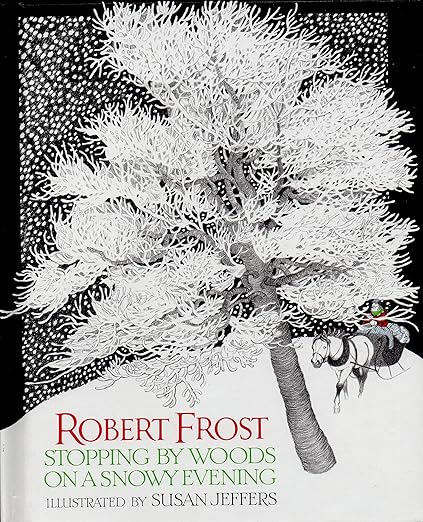
Amazon.com ReviewRobert Frost's well-known poem takes on new life in its first picture-book adaptation. The poem--long appreciated for its strong rhythm and evocative images--leaves readers wondering, "Where was the man going on the darkest night of the year?" and "Why on earth did he stop by the woods in a snowstorm?" Artist Susan Jeffers answers these questions visually--the kindly older gentleman who narrates the poem stops his sleigh to feed the forest birds and creatures. He stops once more to visit his daughter and grandchildren, then is off again through a blizzard, with many miles to go before he can sleep. The silent beauty of a snowy night shines through Jeffers's artwork; the man's clothing and blanket are the only bright touches of color in the white and wintry world of the woods. This quiet yet powerful book has a magic all its own. (Ages 4 to 7)ReviewPoem by Robert Frost, published in the collection New Hampshire (1923). One of his most frequently explicated works, it describes a solitary traveler in a carriage who is both driven by the business at hand and transfixed by a wintry woodland scene. The poem is composed of four iambic tetrameter quatrains, and the meditative lyric derives its incantatory tone from an interlocking rhyme scheme of aaba bbcb ccdc dddd. -- The Merriam-Webster Encyclopedia of Literature About the Author Robert Lee Frost was born in San Francisco in 1874. When he was ten, his father died and he and his mother moved to New England. He attended school at Dartmouth and Harvard, worked in a mill, taught, and took up farming, before he moved to England, where his first books of poetry, A Boy���s Will (1913) and North of Boston (1914), were published. North of Boston brought him recognition as the preeminent voice of New England and as one of America���s major poets. In 1915 he returned to the United States and settled on a farm in New Hampshire. Four volumes of his poetry, New Hampshire (1923), Collected Poems (1930), A Further Range (1936), and A Witness Tree (1942) were all awarded the Pulitzer Prize. He died in 1963. About the AuthorRobert Lee Frost was born in San Francisco in 1874. When he was ten, his father died and he and his mother moved to New England. He attended school at Dartmouth and Harvard, worked in a mill, taught, and took up farming, before he moved to England, where his first books of poetry, A Boy���s Will (1913) and North of Boston (1914), were published. North of Boston brought him recognition as the preeminent voice of New England and as one of America���s major poets. In 1915 he returned to the United States and settled on a farm in New Hampshire. Four volumes of his poetry, New Hampshire (1923), Collected Poems (1930), A Further Range (1936), and A Witness Tree (1942) were all awarded the Pulitzer Prize. He died in 1963.Read more