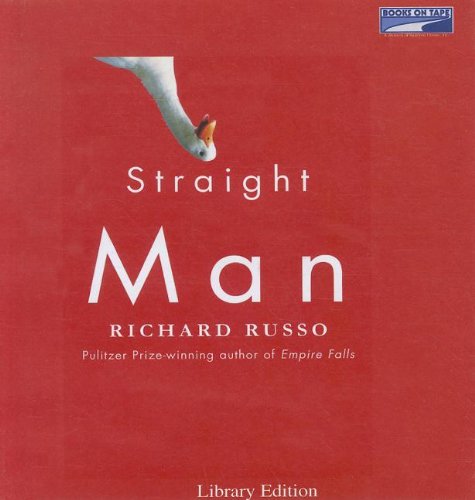
From the Inside FlapWilliam Henry Devereaux, Jr., spiritually suited to playing left field but forced by a bad hamstring to try first base, is the unlikely chairman of the English department at West Central Pennsylvania University. Over the course of a single convoluted week, he threatens to execute a duck, has his nose slashed by a feminist poet, discovers that his secretary writes better fiction than he does, suspects his wife of having an affair with his dean, and finally confronts his philandering elderly father, the one-time king of American Literary Theory, at an abandoned amusement park.Such is the canvas of Richard Russo's Straight Man, a novel of surpassing wit, poignancy, and insight. As he established in his previous books -- Mohawk, The Risk Pool, and Nobody's Fool -- Russo is unique among contemporary authors for his ability to flawlessly capture the soul of the wise guy and the heart of a difficult parent. In Hank Devereaux, Russo has created a hero whose humor and identification with the absurd are mitigated only by his love for his family, friends, and, ultimately, knowledge itself.Unforgettable, compassionate, and laugh-out-loud funny, Straight Man cements Richard Russo's reputation as one of the master storytellers of our time.From the Hardcover edition.About the AuthorRichard Russo is the author of Mohawk, The Risk Pool, and Nobody's Fool, which was made into a a film directed by Robert Benton and starring Paul Newman. He lives in Maine with his wife and two daughters.From the Hardcover edition. Excerpt. © Reprinted by permission. All rights reserved. Chapter IWhen my nose finally stops bleeding and I've disposed of the bloody paper towels, Teddy Barnes insists on driving me home in his ancient Honda Civic, a car that refuses to die and that Teddy, cheap as he is, refuses to trade in. June, his wife, whose sense of self-worth is not easily tilted, drives a new Saab. "That seat goes back," Teddy says, observing that my knees are practically under my chin.When we stop at an intersection for oncoming traffic, I run my fingers along the side of the seat, looking for the release. "It does, huh?""It's supposed to," he says, sounding academic, helpless.I know it's supposed to, but I give up trying to make it, preferring the illusion of suffering. I'm not a guilt provoker by nature, but I can play that role. I release a theatrical sigh intended to convey that this is nonsense, that my long legs could be stretched out comfortably beneath the wheel of my own Lincoln, a car as ancient as Teddy's Civic, but built on a scale more suitable to the long-legged William Henry Devereauxs of the world, two of whom, my father and me, remain above ground.Teddy is an insanely cautious driver, unwilling to goose his little Civic into a left turn in front of oncoming traffic. "The cars are spaced just wrong. I can't help it," he explains when he sees me grinning at him. Teddy's my age, forty-nine, and though his features are more boyish, he too is