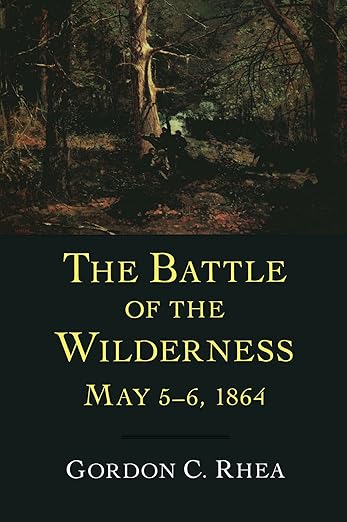
ReviewRhea, a Virginia attorney, offers what will likely become the definitive account of one of the Civil War's most confusing engagements: the Battle of the Wilderness, the first encounter between Ulysses S. Grant and Robert E. Lee, fought in Virginia. The author's reconstruction of the fighting highlights the difficulties of controlling troops once they had been committed to action. Grant's original plan was to maneuver Lee out of his defensive position along the Rapidan River, then crush his troops with superior numbers. Instead, Rhea notes, the Wilderness became a "soldiers' battle," with raw courage compensating for inadequate generalship on both sides. Grant relied too heavily on the Army of the Potomac's commander, George Gordon Meade, who failed to coordinate the movements of subordinates disoriented by the broken ground they fought over. Rhea also criticizes Lee for consistently taking the offensive with an army that could not afford the major losses it sustained in attacking. History Book Club main selection. ― Publishers WeeklyIn a meticulous, exhaustive, yet highly readable account, Thomas has done for the Battle of the Wilderness what others have done for Gettysburg, Antietam, and other Civil War battles. Rhea, an attorney and Civil War buff, gives clear historical treatment to one of the major engagements of the Civil War, the first important battle directed by Ulysses S. Grant after his appointment as general-in-chief of the Federal army. In the tangled, thicketed Virginia forest region south of the Rapidan River, Grant's force of approximately 120,000 was opposed by 65,000 men under the command of Robert E. Lee. The Union push was to be the beginning of Grant's campaign to capture Richmond, the Confederate capital. Though his army outnumbered Lee's by almost two to one, Grant met with stiff resistance, and the dense woods made fighting almost impossible. In the end, after both sides suffered heavy casualties, the battle was indecisive. Rhea views the engagement in the context of the increasingly desperate Southern situation in mid-1864 as resources became ever more scarce. He also relates the story of an important, little-known precursor to the battle: a disastrous foray by Federal troops against entrenched Confederates at Morton's Ford on the Rapidan in February of the same year. His narrative brings to life not only Grant, Lee, and James Longstreet, but also lesser known figures like ``Brains'' Halleck (Grant's predecessor as commander) and Gen. John Sedgwick (who commanded the 8th Pennsylvania Cavalry in the Wilderness and had previously, against his better judgment, commanded the attack at Morton's Ford). An extremely helpful appendix contains the complete order of battle for both sides. All future accounts of the battle will be measured against this work. Scholars and buffs alike will find the volume enthralling. (History Book Club main selection) ― Kirkus ReviewsThis is the latest entry in the new category of regiment-b