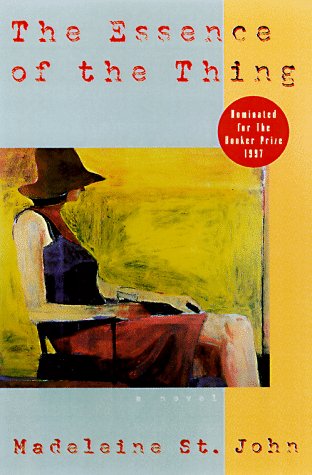
From Library JournalNominated for the 1997 Booker Prize, this third novel by St. John (The Women in Black, Ulverscroft, 1994) is a magnetic story about what happens to a couple in the aftermath of their relationship. Set in contemporary England, the novel begins when Jonathan abruptly breaks up with Nicola and asks her to move out. Nicola, who had thought that all was well with their relationship, seeks a reason for this unexplained breakup. With the support of friends, Nicola lets go of Jonathan, her feelings evolving slowly from devastation to independence and strength. At the same time, St. John reveals Jonathan's emptiness, his deteriorating world, and his realization that he may have made the biggest mistake of his life. St. John addresses all the subtle details pertaining to starting one's life again after breaking up. Readers will be drawn into this remarkable novel by the author's ability to convey the feelings of Nicola and Jonathan with conviction. Recommended for all libraries.?Judith Ann Akalaitis, formerly with the Supreme Court of Illinois Lib., ChicagoCopyright 1998 Reed Business Information, Inc.From BooklistJonathan and Nicola were in love when he moved into her flat on Notting Hill in London. A few short years later, Nicola finds herself in a state of shock when, seemingly out of the blue, Jonathan announces that the relationship is over. Nicola reluctantly agrees, but in the process of starting a new life, she discovers some interesting things about herself, not the least of which is that she likes to have a good time--something the stodgily conservative Jonathan wasn't able to offer. Brisk dialogue and narrative that stays in the moment capture the essence of the experience nicely without need for analysis or explanation. The story reveals the full range of emotions that comes with the breakup of a relationship, including doubt. St. John delivers a realistically "untidy" ending that invites contemplation of several possibilities for the future. The endearing Nicola arouses within readers a feeling of wanting the best for her, although it isn't clear what that might be. Even doleful Jonathan eventually evokes a bit of sympathy. Grace Fill Review ...a brisk, sophisticated and artful narrative buoyed by an ironic use of the religious imagery of hell, salvation and resurrection. -- The New York Times Book Review, Gardner McFall Review...a brisk, sophisticated and artful narrative buoyed by an ironic use of the religious imagery of hell, salvation and resurrection. -- The New York Times Book Review, Gardner McFallRead more