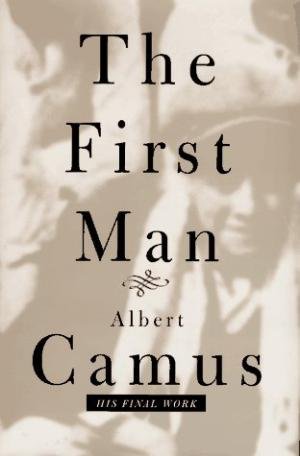
From the Inside FlapIn The First Man Albert Camus tells the story of Jacques Cormery, a boy who lived a life much like his own. Camus summons up the sights, sounds, and textures of a childhood circumscribed by poverty and a father's death yet redeemed by the austere beauty of Algeria and the boy's attachment to his nearly deaf-mute mother. The result is a moving journey through the lost landscape of youth that also discloses the wellspring of Camus' aesthetic powers and moral vision.About the AuthorBorn in Algeria in 1913, Albert Camus published The Stranger-- now one of the most widely read novels of this century-- in 1942. Celebrated in intellectual circles, Camus was awarded the Nobel Prize for Literature in 1957. On January 4, 1960, he was killed in a car accident. Excerpt. © Reprinted by permission. All rights reserved. Intercessor: Widow CamusTo you who will never be able to read this bookAbove the wagon rolling along a stony road, big thick clouds were hurrying to the East through the dusk. Three days ago they had inflated over the Atlantic, had waited for a wind from the West, had set out, slowly at first then faster and faster, had flown over the phosphorescent autumn waters, straight to the continent, had unraveled on the Moroccan peaks, had gathered again in flocks on the high plateaus of Algeria, and now, at the approaches to the Tunisian frontier, were trying to reach the Tyrrhenian Sea to lose themselves in it. After a journey of thousands of kilometers over what seemed to be an immense island, shielded by the moving waters to the North and to the South by the congealed waves of the sands, passing scarcely any faster above this nameless country than had empires and peoples over the millennia, their momentum was wearing out and some already were melting into occasional large raindrops that were beginning to plop on the canvas hood above the four travelers.The wagon was creaking over a route that was fairly well marked but had scarcely any surfacing. From time to time a spark would flash under a metal wheel rim or a horse's hoof, and a stone would strike the wood of the wagon or else would sink with a muted sound into the soft soil of the ditch. Meanwhile the two small horses moved steadily ahead, occasionally flinching a bit, their chests thrust forward to pull the heavy wagon, loaded with furniture, continuously putting the road behind them as they trotted along at different paces. One of them would now and then blow the air noisily from its nostrils, and would be thrown off its pace. Then the Arab who was driving would snap the worn reins flat on its back, and the beast would gamely pick up its rhythm.The man who was on the front seat by the driver, a Frenchman about thirty, gazed with an impenetrable look at the two rumps moving rhythmically in front of him. He was of medium height, stocky, with a long face, a high square forehead, a strong jaw, and blue eyes. Though the season was well along, he wore a three-button duckcloth jac