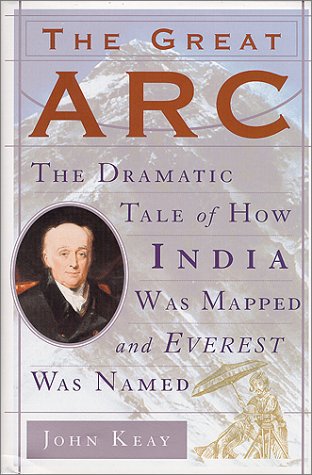
From BooklistSeemingly there's no rest for Keay, who since his magisterial India: A History has dashed off this captivating story about the Great Trigonometrical Survey of India. If only writing were that easy: this book has clearly percolated in the author's mind for some time, and he brings to it his steeping in the subcontinent's past, his attuned descriptions of its landscapes and climate, and, above all, an elegant style that brings to life the personalities of the surveyors. The survey was the brainchild of William Lambton, an idiosyncratic British army officer to whom no memorial exists save his crumbling tombstone in central India, which Keay had difficulty even finding. Keay dispels as much of Lambton's obscurity as the man's taciturnity about himself allows; but, when the subject was theodolites and trigonometry, Lambton was positively effusive. Clearly taken by Lambton, Keay recounts how he, through a fortuitous connection with Arthur Wellesley (the future Duke of Wellington), persuaded colonial officials to sanction his survey in 1800, officials who probably were clueless that Lambton intended to map all of India as a means of determining the exact shape of the earth--or that the survey would consume the better part of the century. The scientific cavalcade's tone altered markedly with the succession, after Lambton's death in 1823, by the more personally revealing but infinitely more irascible George Everest. Keay makes clear Everest was competent but disliked, lending a note of ironic oddity that his name, rather than Lambton's or some local name, became attached to the highest peak in the Himalaya. In Keay's hands, this once-obscure story makes for marvelous, cover-to-cover reading. Gilbert TaylorCopyright © American Library Association. All rights reservedAbout the AuthorJohn Keay is the author of four acclaimed histories: The Honourable Company, about teh East India Company; Last Post, about imperical disengagement in the Far East; the two-volume Explorers of the Western Himalayas; and most recently, India: A History. His other books include India Discovered and Into India. John Keay is married with four children, lives in Scotland and is co-editor with Julia Keay of the Collins Encyclopedia of Scotland.John Keay is the author of four acclaimed histories: The Honourable Company, about teh East India Company; Last Post, about imperical disengagement in the Far East; the two-volume Explorers of the Western Himalayas; and most recently, India: A History. His other books include India Discovered and Into India. John Keay is married with four children, lives in Scotland and is co-editor with Julia Keay of the Collins Encyclopedia of Scotland. Excerpt. © Reprinted by permission. All rights reserved. Chapter One A Baptism of FeverThe word 'jungle' comes from India. In its Hindi form of jangal, it denotes any area of uncultivated land. Indian jungles are not necessarily forested, and today less so than ever. But well away from centres of