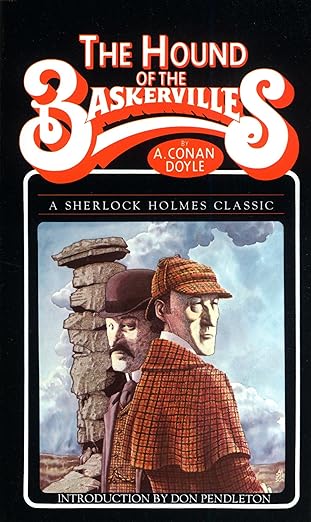
Review“The whole Sherlock Holmes saga is a triumphant illustration of art’s supremacy over life.” -Christopher MorleyFrom the Inside FlapThe curse of the Baskervilles began in the 17th Century, when Sir Hugo swore he would give his soul to possess the beautiful daughter of a yeoman. He captured her, but she escaped. He saddled his horse and chased the girl over the moors until she dropped dead from exhaustion . . . and then a black hell-hound appeared, with eyes like fire, and ripped out Hugo's throat. Now, years later, the Hound has returned. Already it has caused the death of Hugo's descendant, Sir Charles Baskerville. Can Sherlock Holmes stop the curse before it claims Henry Baskerville, the heir of Sir Charles? From the Back Cover The Hound of the Baskervilles is the tale of an ancient curse suddenly given a terrifying modern application. The grey towers of Baskerville Hall and the wild open country of Dartmoor hold many secrets for Holmes and Watson to unravel. The detective is contemptuous of supernatural manifestations, but the reader will remain perpetually haunted by the hound from the moor. About the Author Laurie R. King is the New York Times bestselling author of twelve Mary Russell mysteries (one of which, The Moor, was inspired in part by The Hound of the Baskervilles), five contemporary novels featuring Kate Martinelli, and the acclaimed novels A Darker Place, Folly, Keeping Watch, and Touchstone. She lives in Northern California. Excerpt. © Reprinted by permission. All rights reserved. CHAPTER I Mr. Sherlock HolmesMr. Sherlock Holmes, who was usually very late in the mornings, save upon those not infrequent occasions when he stayed up all night, was seated at the breakfast table. I stood upon the hearth-rug and picked up the stick which our visitor had left behind him the night before. It was a fine, thick piece of wood, bulbous-headed, of the sort which is known as a “Penang lawyer.” Just under the head was a broad silver band, nearly an inch across. “To James Mortimer, M.R.C.S., from his friends of the C.C.H.,” was engraved upon it, with the date “1884.” It was just such a stick as the old-fashioned family practitioner used to carry-dignified, solid, and reassuring. “Well, Watson, what do you make of it?” Holmes was sitting with his back to me, and I had given him no sign of my occupation. “How did you know what I was doing? I believe you have eyes in the back of your head.” “I have, at least, a well-polished, silver-plated coffee-pot in front of me,” said he. “But, tell me, Watson, what do you make of our visitor’s stick? Since we have been so unfortunate as to miss him and have no notion of his errand, this accidental souvenir becomes of importance. Let me hear you reconstruct the man by an examination of it.” “I think,” said I, following so far as I could the methods of my companion, “that Dr. Mortimer is a successful elderly medical man, well-esteemed, since those who know him g