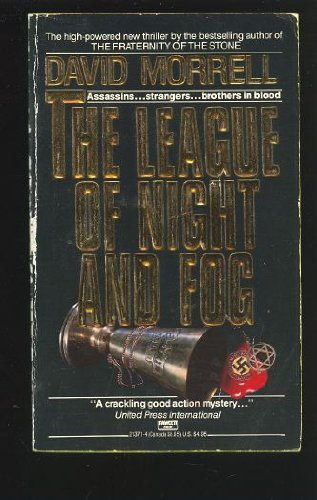
ReviewMorrell, whose career nose-dived after his superb debut in First Blood, here sequels his two recent, commercially-hot thrillers, the so-so The Brotherhood of the Rose and The Fraternity of the Stone (better). But by recycling these novels' heroes into a flimsy vengeance plot stilted up on a thin premise (death-camp victims attacking their Nazi tormentors), he indicates that he's again running out of steam. In the novel's first half, Morrell confusingly intercuts three plot lines, starting with the disappearance around the globe of old men: Jews, Germans, and a prominent Vatican Cardinal. Two of the Germans' sons, free-lance assassins named Icicle and Seth, fly to Rome to find the Cardinal, believing him the key to the disappearances. Meanwhile in Israel, ex-CIA killer Saul, hero of The Brotherhood of the Rose, learns that his wife's father, a former death-camp inmate obsessed with Nazis, is one of the missing. With his ex-Mossad-agent wife, Saul flees to Europe to find him. At the same time in the Egyptian desert, another ex-CIA killer, Drew, now a hermit (and a leftover from The Fraternity of the Stone), is summoned via his ex-CIA-agent lover Arlene by the Fraternity (an order of priest/assassins) to find the misplaced Cardinal. The three pairs of superspys wade through a lot of bloody and mostly dull mayhem (a tense stalk-and-fight between Saul and Fraternity members is the sole exception) until Saul and Drew meet, joining forces in Rome. There they battle Icicle and Seth (who fight each other when not busy torturing Saul's now-captive wife). In between the gore, Saul and Drew learn that the Cardinal, pro-Nazi, is dead at the hands of an outraged priest, and that the missing Germans, all ex-Nazis, have been snatched by the missing Jews. A tepid confrontation between assassins, Germans, and Jews winds things down, leaving room for, alas, yet another sequel. Contrived, clumsy, and overcomplicated: Morrell's weakest novel yet. (Kirkus Reviews) --Kirkus ReviewsAbout the AuthorMy father was killed during World War II, shortly after I was born in 1943. My mother had difficulty raising me and at the same time holding a job, so she put me in an orphanage and later in a series of boarding homes. I grew up unsure of who I was, desperately in need of a father figure. Books and movies were my escape. Eventually I decided to be a writer and sought help from two men who became metaphorical fathers to me: Stirling Silliphant, the head writer for the classic TV series "Route 66" about two young men in a Corvette who travel America in search of themselves, and Philip Klass (whose pen name is William Tenn), a novelist who taught at the Pennsylvania State University where I went to graduate school from 1966 to 1970. The result of their influence is my 1972 novel, First Blood, which introduced Rambo. The search for a father is prominent in that book, as it is in later ones, most notably The Brotherhood of the Rose (1984), a thriller about orphans and spies.