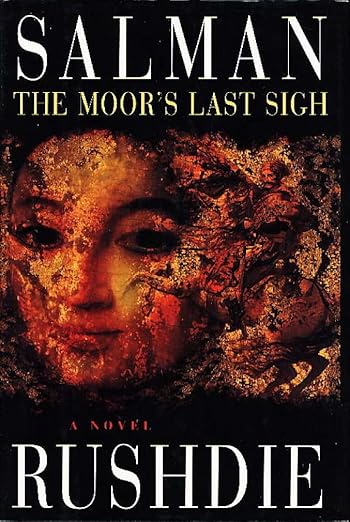
Amazon.com ReviewIn The Moor's Last Sigh Salman Rushdie revisits some of the same ground he covered in his greatest novel, Midnight's Children. This book is narrated by Moraes Zogoiby, aka Moor, who speaks to us from a gravestone in Spain. Like Moor, Rushdie knows about a life spent in banishment from normal society--Rushdie because of the death sentence that followed The Satanic Verses, Moor because he ages at twice the rate of normal humans. Yet Moor's story of travail is bigger than Rushdie's; it encompasses a grand struggle between good and evil while Moor himself stands as allegory for Rushdie's home country of India. Filled with wordplay and ripe with humor, it is an epic work, and Rushdie has the tools to pull it off. He earned a 1995 Whitbread Prize for his efforts.From Library JournalMoraes Zogoiby, the product of a mixed marriage, is a self-described "cathjew nut" living in the multicultural stewpot of Bombay. His freethinking mother, Aurora, heiress to a vast spice trade fortune and reputedly a descendant of Vasco da Gama, decorates his nursery with murals featuring American cartoon characters instead of the traditional Hindu deities. Young Moraes's cultural identity is so confused that his favorite Indian is Tonto, from The Lone Ranger. Aurora is also a renowned artist, and the book's title refers to her masterpiece, which has been stolen by a rival and smuggled out of the country. Moraes's frantic search for the painting is complicated by the fact that he ages at twice the normal speed and is quickly running out of time. This rich and very readable novel is filled with playful allusions to postwar Indian history, world literature, pop culture, and Rushdie's own recent travails. On a par with the marvelous Midnight's Children (LJ 2/15/81), this is Rushdie's best work in years.-?Edward B. St. John, Loyola Law Sch. Lib., Los AngelesCopyright 1995 Reed Business Information, Inc. From Booklist Rushdie's first novel since the fateful Satanic Verses (1989) is about hybridization of cultures, and itself seems a hybrid between William Faulkner's Yoknapatawpha County novels and The Thousand and One Nights. This four-generational family saga takes place in Rushdie's native southern India and witnesses the decline of a spice-trading dynasty, a century-long drama of "family rifts and premature deaths and thwarted loves and mad passions and weak chests and power and money and the even more morally dubious seductions and mysteries of art." The fanciful tale is related by the last of the exhausted family line, Moraes Zogoiby, son of a pair of Indians of far different backgrounds and persuasions, his father Jewish and a Mob leader in Bombay, his mother Catholic and celebrated for her artistry. The "Moor," as he is called, was born physically precocious; in fact, he ages at twice the normal rate. The plot does not unfold--it floods like a river gone over its banks, exploding with incredible events and larger-than-life characters, and to be carried alo