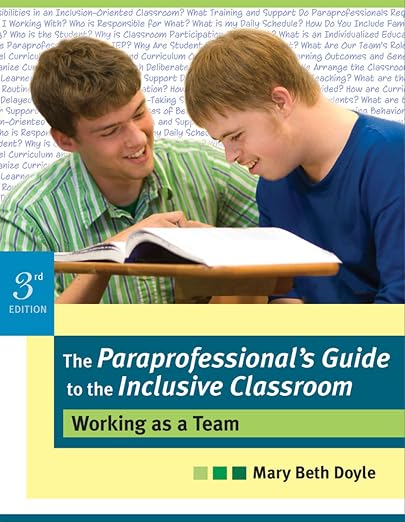
The paraprofessional's guide to the inclusive classroom

3rd Edition

By Mary Beth Doyle

ISBN: 1557669244
Publisher: Brookes Publishing
Year: 2008
Pages: 192

About This Book

With the rising demand for paraprofessional training and the requirements for highly qualified personnel in every classroom, it's the perfect time for a fully revised third edition of this popular, activity-packed workbook. Carefully updated throughout with timely, engaging new material, this interactive guide helps teachers and paraprofessionals work together to create the most effective inclusive classrooms. Collaborating on creative and enlightening activities, teachers and paraprofessionals will learn how towork more effectively with students who have a variety of disabilities, including autismclarify their roles and responsibilitiesprovide individualized curricular and instructional support for each studentimprove communication among members of the educational teamuse positive behavioral support to successfully address behavior challengesA must-have new edition of a book that's sold more than 10,000 copies since 1997, this research-based and user-friendly workbook will help paraprofessionals and teachers work toward their common goal: creating classroom and school communities that welcome and support all students.What's Newapproximately 20 new photocopiable forms and exercisesthe very latest on education legislation and requirementsstronger emphasis on middle and secondary schoolguidelines in every chapter that help paraprofessionals self-advocatenew chapter on team communication and confidentiality

Product Details

Publisher Brookes Publishing
Publication date January 1, 2008
Language English
Print length 192 pages
ISBN-10 1557669244
ISBN-13 978-1557669247
Item Weight 1.2 pounds

Editorial Reviews

Editorial Review

Review "Offers tons of practical ideas and suggestions that reflect recommended practices . . . any paraprofessional would find this a terrific resource and greatly needed aid." -- June Downing, Ph.D.About the Author Mary Beth Doyle, Ph.D., works for the Vermont Department of Education as Project Coordinator of Vermont's Higher Education Collaborative to increase the number of licensed special education teachers available to the state's public schools. This project is aimed at providing field-based access to higher education for teachers in rural communities around the state. A unique aspect of this project is the partnerships that have been established among the University of Vermont, Castleton State College, Johnson State College, Lyndon State College, and St. Michael's College. These higher education institutions are working together with the state Department of Education and school districts on the design and delivery of instruction as well as administrative issues to create a strategic approach to issues of limited access to higher education for teachers around the state. The majority of Mary Beth's work has focused on creating positive learning communities for all children in which adults create a sense of welcome. To this end, Mary Beth's writing and training activities focus on issues of curriculum adaptations, paraprofessional teaming, and collaboration. Excerpt. © Reprinted by permission. All rights reserved. Excerpted from Chapter 5 of The Paraprofessional's Guide to the Inclusive Classroom, Third Edition, by Mary Beth DoyleCopyright © 2008 by Mary Beth Doyle. All rights reserved. No part of this excerpt may be reproduced or reprinted without permission in writing from the publisher.As you read about the role of paraprofessionals in supporting students who display challenging behaviors, it is important to remember that everyone engages in a variety of behaviors to communicate their needs, wants, and desires. Sometimes their behaviors align with their intentions; sometimes they do not. Often, people rely on others to interpret their behaviors and respond to them; when others respond in a way that does not align with their intentions, they simply clarify the intended meaning. For some students, behaviors are the primary ways in which they communicate, and many of these students do not have the ability to clarify their intentions through language (e.g., speech, sign language, picture communication). For example, on a hot day a student with severe disabilities begins to get upset and cries. The adult responds by giving the student a drink of water. The student continues to cry and the adult is perplexed as to why the student's behavior does not change. The short answer is that the adult's response did not match the student's communication intent. Perhaps the student wasn't thirsty, but hungry; perhaps the student wanted to go swimming or had a headache.Whatever the student's intention, the adult missed the mark. To minimize such misunder
Shipping set per seller
Compare book + shipping totals for each offer
Seller-error returns
Returns accepted for seller errors. Ask the seller about change-of-mind returns
Partner purchases
MedicalBook.online handles payment, shipping and returns for its orders
Email Support
[email protected] for buyers and sellers