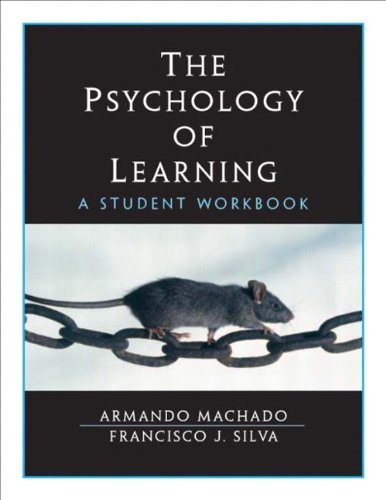
The Psychology of Learning

Workbook Edition

By Armando Machado, Francisco J. Silva

ISBN: 0130917680
Publisher: Pearson
Year: 2003
Pages: 169

About This Book

This unique workbook promotes an active, hands-on, constructivist approach to the study of the Psychology of Learning, one that follows Bloom's (1956) taxonomy of instructional objectives. The constructivist approach encourages the reader to discover the answers to problems rather than simply look up solutions in a book. This approach assumes that, for information to be remembered, the reader must discover information and manipulate it by checking new information against old information, revising assumptions, beliefs, and knowledge when the old information no longer seems to work. This workbook replaces the passivity of memorizing definitions and procedures with the activities of graphing and interpreting of functional relations-the pillars of theory. Learning and Variables; Functions and Graphs; Basic Principles of Pavlovian Conditioning; Complexities of Pavlovian Conditioning; The Rescorla-Wagner Model; Principles of Operant Conditioning; "Creating" Behavior (Shaping); Schedules of Reinforcement; What Is a Reinforcer?; Punishment and Avoidance; "Simple" Stimulus Control; "Complex" Stimulus Control (Cognitive Processes); Choice and Self-Control (Allocation of Behavior).

Product Details

Publisher Pearson
Publication date January 1, 2003
Language English
Print length 169 pages
ISBN-10 0130917680
ISBN-13 978-0130917683
Item Weight 0.75 pounds

Editorial Reviews

Editorial Review

From the Back CoverThis unique workbook promotes an active, hands-on, constructivist approach to the study of the Psychology of Learning, one that follows Bloom's (1956) taxonomy of instructional objectives. The constructivist approach encourages the reader to discover the answers to problems rather than simply look up solutions in a book. This approach assumes that, for information to be remembered, the reader must discover information and manipulate it by checking new information against old information, revising assumptions, beliefs, and knowledge when the old information no longer seems to work. This workbook replaces the passivity of memorizing definitions and procedures with the activities of graphing and interpreting of functional relations—the pillars of theory. Learning and Variables; Functions and Graphs; Basic Principles of Pavlovian Conditioning; Complexities of Pavlovian Conditioning; The Rescorla-Wagner Model; Principles of Operant Conditioning; "Creating" Behavior (Shaping); Schedules of Reinforcement; What Is a Reinforcer?; Punishment and Avoidance; "Simple" Stimulus Control; "Complex" Stimulus Control (Cognitive Processes); Choice and Self-Control (Allocation of Behavior).Excerpt. © Reprinted by permission. All rights reserved. Historically, the study of learning has been at the center of American and British psychology. Thousands of books and research articles have been written on the subject. Even to the casual reader, it is clear that there is no shortage of published materials on learning. Historically, the study of learning has been at the center of American and British psychology. Thousands of books and research articles have been written on the subject. Even to the casual reader, it is clear that there is no shortage of published materials on learning. With regard to textbooks, however, we believe the currently available choices fall short in two major ways. First, the goal of condensing the large domain of learning into a textbook of manageable size often results in a dense, encyclopedic, and overwhelmingly passive presentation of historical and contemporary findings. Inevitably, perhaps, the most common remark we have heard from students of learning concerning their textbook is, "Boring!" Second, functional relations, when presented at all, are buried under a pile of facts and experimental procedures. As a consequence, students' learning is impoverished because the variation of functions is overshadowed by the variety of facts; the primary is overshadowed by the secondary. Worst of all, the skills required to understand and use functional relations—skills crucial in learning as in any other experimental science—are simply not taught. With regard to textbooks, however, we believe the currently available choices fall short in two major ways. First, the goal of condensing the large domain of learning into a textbook of manageable size often results in a dense, encyclopedic, and overwhelmingly passive presentation of his
Shipping set per seller
Compare book + shipping totals for each offer
Seller-error returns
Returns accepted for seller errors. Ask the seller about change-of-mind returns
Partner purchases
MedicalBook.online handles payment, shipping and returns for its orders
Email Support
[email protected] for buyers and sellers