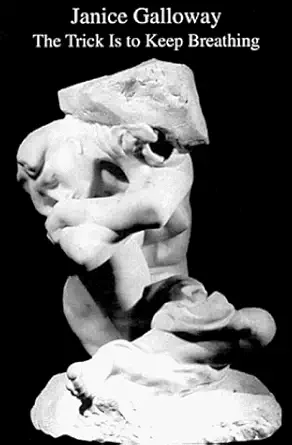
From Library JournalImagine yourself walking across a tightrope that doesn't stay taut and perfectly still, so that keeping your balance is difficult. This is Joy Stone's task. A prolonged depression, the source of which is never identified, propels her to a psychiatric hospital for help. But help is what she gets precious little of, in spite of meeting with a bunch of generally nameless doctors-a simple yet brilliant way to depict the impersonal nature of the hospital and how doctors and patients interact. Joy narrates by means of journal entries interspersed with letters and snippets of songs or poems, and vivid descriptions stand out. Joy does not indulge in self-pity about her depression or guilt over the accidental death of the married man with whom she had an affair. The journal format makes the book seem choppy at times, but the choppiness reinforces the sense of being off balance. Joy leaves the hospital just as she entered it-voluntarily. This absorbing winner of a Scottish Arts Council Book Award and shortlisted entry for the Whitbread First Novel Award and the Scottish First Book of the Year is for most fiction collections.Lisa Nussbaum, Euclid P.L., OhioCopyright 1994 Reed Business Information, Inc.From BooklistGalloway is a young Scot whose first novel is fairly mature and very good, thank you. Its protagonist is 27-year-old drama teacher Joy Stone, who is in the clutches of a deep and somewhat mysterious depression. The narrative takes the form of Joy's somewhat disjointed first-person account of her confused and deteriorating mental state and her increasingly inadequate efforts to deal with daily life. As the book unfolds, Joy submits to a course of treatment in a psychiatric ward, reemerging to continue somewhat better but by no means cured. Galloway has an uncanny knack for presenting the disturbed Joy from the inside out, managing a credible and, indeed, compelling account of Joy's daily despair. The writing is artistic--strong, gritty, mordant in its black wit, effective at conveying the fragmented life of its subject. Galloway is at work on a second novel, which, on the evidence of the first, should be worth waiting for. John Shreffler From Kirkus Reviews A superbly rendered first-person narrative about a depressed woman who may or may not be getting better, this novel was first published in Scotland and shortlisted for the Whitbread First Novel Award. Galloway's sheaf of stories, Blood (1991), was seen here as bleak, powerful, uneven. Here, Galloway all but drowns herself in her scrambled heroine, Joy Stone, a 27-year-old drama teacher who lives outside Glasgow with trembling nerves and a superfine sensitivity to all shades of overcast. Be warned, Galloway's lyric psychological realism is as dense as Virginia Woolf's Mrs. Dalloway and To the Lighthouse, her page an inventive litter of relentless subjectivity. Joy Stone is not the manic-depressive her name implies; she's just depressed and locked into endless black chat with h