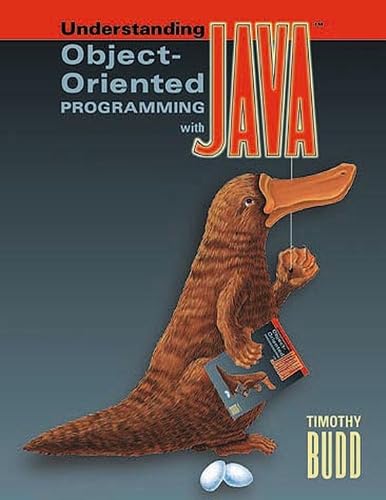
Understanding object-oriented programming with Java

By Timothy Budd

ISBN: 0201308819
Publisher: Addison-Wesley
Year: 1998
Pages: 367

About This Book

Timothy Budd, leading author, educator and researcher in the object-oriented programming community, provides a deep understanding of object-oriented programming and Java. Understanding Object-Oriented Programming with Java teaches readers why the Java language works the way it does, as opposed to many other books that focus on how Java works. Readers learn about the development decisions that went into making the Java language, and leave with a more sophisticated knowledge of Java and how it fits in the context of object-oriented programming. Throughout the text, the focus remains on teaching readers to master the necessary object-oriented programming concepts. Dr. Budd explains to the reader in clear and simple terms the fundamental principles of object-oriented programming, illustrating these principles with extensive examples from the Java standard library. In short, he thoughtfully created this book, not as a reference manual for the Java language, but as a tool for understanding Java and the object-oriented programming philosophy. Highlights: Provides several graduated example programs in Part II (i.e., cannon and pinball games) for readers to work through and successively learn object-oriented programming features. Includes extensive examples from the Java standard library so that readers can better understand the many design patterns found in the AWT, the multiple purposes for which inheritance is used in the standard classes, and more. Discusses features of Java in Part V that are important for students to understand, but not necessarily notable for their object-oriented features. Instructors have the flexibility to omit altogether, or introduce in parallel with earlier material.

Product Details

Publisher Addison-Wesley
Publication date January 1, 1998
Language English
Print length 367 pages
ISBN-10 0201308819
ISBN-13 978-0201308815
Item Weight 1.3 pounds

Editorial Reviews

Editorial Review

From the Inside FlapThere are many books on Java that teach you how to use the language, but few books that teach you why the language works in the way that it does. Many books help you learn the mechanics of Java programming; few books teach you the deeper issues that lie behind the programming syntax. The goal of this book is to give the reader a fuller, more complete understanding of the philosophy behind Java, not just the mechanics of the language. Many books help you learn the mechanics of Java programming; few books teach you the deeper issues that lie behind the programming syntax. The goal of this book is to give the reader a fuller, more complete understanding of the philosophy behind Java, not just the mechanics of the language. Throughout the book these principles and practices are illustrated with exten-sive examples from the Java standard library. Here you can learn, for example, the many design patterns that are found in the AWT, the multitude of purposes for which inheritance is used in the standard classes, and why there are 22 dif-ferent types of input/output file streams. Here you can discover why the lack of an ordered container class in the standard library is not a simple omission, but is instead a re ection of a fundamental and deep property of the Java language. In short, this book should not be considered a reference manual for the Java language, but rather a tool for understanding the Java philosophy. Throughout the book these principles and practices are illustrated with exten-sive examples from the Java standard library. Here you can learn, for example, the many design patterns that are found in the AWT, the multitude of purposes for which inheritance is used in the standard classes, and why there are 22 dif-ferent types of input/output file streams. Here you can discover why the lack of an ordered container class in the standard library is not a simple omission, but is instead a re ection of a fundamental and deep property of the Java language. In short, this book should not be considered a reference manual for the Java language, but rather a tool for understanding the Java philosophy.Structure of the Book The book is structured in five major sections:Structure of the Book The book is structured in five major sections: Part 1 is a general, language-independent introduction to the ideas that lie at the heart of the Java world. The first major object-oriented concepts, those of classes, encapsulation, behavior, and responsibilities, will be introduced in this part and reinforced in Part 2. Here the student will be introduced to the idea that the solution to a problem can be structured as interactions among a community of agents. The second chapter of Part 1 presents a brief history of the development of Java, and can be omitted at the instructor's discretion. However, Chapter 3, on design, should in no way be avoided. In fact, I strongly encourage students to conduct at least one, if not several, design exercises using
Shipping set per seller
Compare book + shipping totals for each offer
Seller-error returns
Returns accepted for seller errors. Ask the seller about change-of-mind returns
Partner purchases
MedicalBook.online handles payment, shipping and returns for its orders
Email Support
[email protected] for buyers and sellers