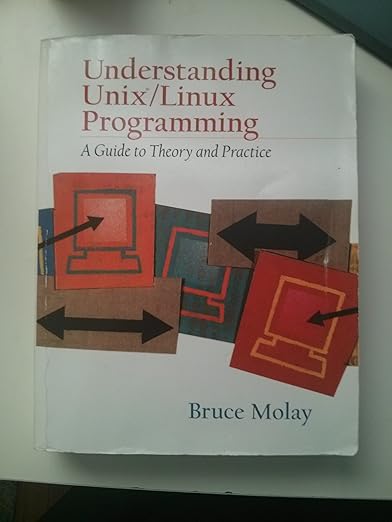
Review"The material covered goes to the right depth to allow students to understand the UNIX operating system to program it. I wish a book of this calibre was available during my graduate studies as it would have helped me tremendously in learning to program the UNIX system." ― Sam R. Thangiah, Slippery Rock University"The material covered goes to the right depth to allow students to understand the UNIX operating system to program it. I wish a book of this calibre was available during my graduate studies as it would have helped me tremendously in learning to program the UNIX system." ― Sam R. Thangiah, Slippery Rock University "This text is one of the most accurate and articulate that I have read. It is easily readable." ― Lawrence B. Wells, Dallas County Community College"This text is one of the most accurate and articulate that I have read. It is easily readable." ― Lawrence B. Wells, Dallas County Community College From the Back CoverUnderstanding Unix®/Linux Programming explains how Unix and Linux work and shows how to write, programs at the system call level. Using nearly 100 complete programs and over 200 illustrations, the book demonstrates the basics as well as the advanced aspects of Unix systems programming. Understanding Unix®/Linux Programming explains how Unix and Linux work and shows how to write, programs at the system call level. Using nearly 100 complete programs and over 200 illustrations, the book demonstrates the basics as well as the advanced aspects of Unix systems programming. Topics include:file I/0 file I/0 device I/0device I/0timerstimersprocess managementprocess managementstream and datagram socketsstream and datagram socketsPOSIX threadsPOSIX threadsfile systemsfile systemsthe terminal driverthe terminal driversignalssignalspipespipesnetwork programmingnetwork programmingsemaphoressemaphores The text presents theory in practical contexts with detailed explanations of common Unix programs such as who, Is, pwd, sh, and httpd. Each example starts with a description of what the program does and how people use it. From there, the text discusses the underlying principles and mechanisms, and then uses those ideas to write a version of the program. The text presents theory in practical contexts with detailed explanations of common Unix programs such as who, Is, pwd, sh, and httpd. Each example starts with a description of what the program does and how people use it. From there, the text discusses the underlying principles and mechanisms, and then uses those ideas to write a version of the program. The book is designed for learning. Chapter summaries, memorable analogies, experiments, explorations, and varied exercises help the reader understand and program Unix as an integrated, logical whole. The book is designed for learning. Chapter summaries, memorable analogies, experiments, explorations, and varied exercises help the reader understand and program Unix as an integrated, logical whole. Material in the book applie