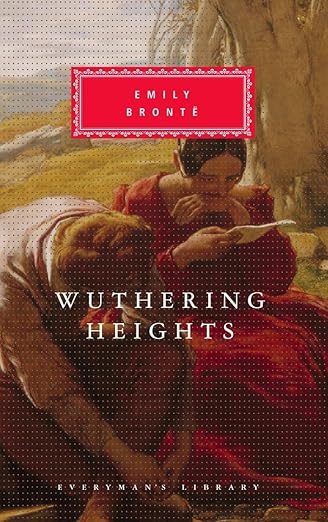
Review"It is as if Emily Brontë could tear up all that we know human beings by, and fill these unrecognizable transparencies with such a gust of life that theytranscend reality."--Virginia WoolfFrom the Inside FlapVirginia Woolf said of Emily Bronte that her writing could "make the wind blow and the thunder roar," and so it does in Wuthering Heights. Catherine Earnshaw, Heathcliff, and the windswept moors that are the setting of their mythic love are as immediately stirring to the reader of today as they have been for every generation of readers since the novel was first published in 1847. With an introduction by Katherine Frank. From the Back Cover Emily Bronte's only novel appeared to mixed reviews in 1847, a year before her death at the age of thirty. In the relationship of Cathy and Heathcliff, and in the wild, bleak Yorkshire Moors of its setting, Wuthering Heights creates a world of its own, conceived with a disregard for convention, an instinct for poetry and for the dark depths of human psychology that make it one of the greatest novels of passion ever written. About the Author Emily Jane Brontë was the most solitary member of a unique, tightly-knit, English provincial family. Born in 1818, she shared the parsonage of the town of Haworth, Yorkshire, with her older sister, Charlotte, her brother, Branwell, her younger sister, Anne, and her father, The Reverend Patrick Brontë. All five were poets and writers; all but Branwell would publish at least one book.Fantasy was the Brontë children’s one relief from the rigors of religion and the bleakness of life in an impoverished region. They invented a series of imaginary kingdoms and constructed a whole library of journals, stories, poems, and plays around their inhabitants. Emily’s special province was a kingdom she called Gondal, whose romantic heroes and exiles owed much to the poems of Byron.Brief stays at several boarding schools were the sum of her experiences outside Haworth until 1842, when she entered a school in Brussels with her sister Charlotte. After a year of study and teaching there, they felt qualified to announce the opening of a school in their own home, but could not attract a single pupil.In 1845 Charlotte Brontë came across a manuscript volume of her sister’s poems. She knew at once, she later wrote, that they were “not at all like poetry women generally write…they had a peculiar music-wild, melancholy, and elevating.” At her sister’s urging, Emily’s poems, along with Anne’s and Charlotte’s, were published pseudonymously in 1846. An almost complete silence greeted this volume, but the three sisters, buoyed by the fact of publication, immediately began to write novels. Emily’s effort was Wuthering Heights; appearing in 1847 it was treated at first as a lesser work by Charlotte, whose Jane Eyre had already been published to great acclaim. Emily Brontë’s name did not emerge from behind her pseudonym of Ellis Bell until the second edition of her n