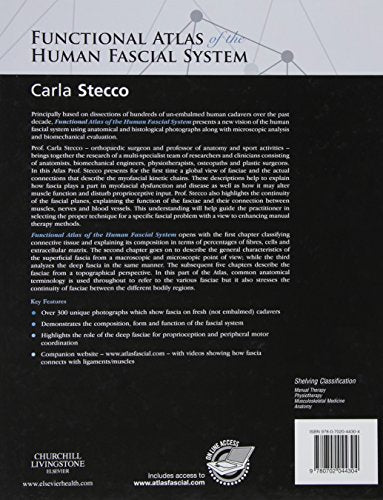
Functional Atlas of the Human Fascial System
Functional Atlas of the Human Fascial System
Couldn't load pickup availability
Author: Stecco MD, Carla
Brand: Churchill Livingstone
Edition: 1
Number Of Pages: 384
EAN: 9780702044304
Release Date: 21-01-2015
Package Dimensions: 11.1 x 8.9 x 1.1 inches
Languages: English
Binding: Hardcover
Part Number: 40999643
Details: Principally based on dissections of hundreds of un-embalmed human cadavers over the past decade, Functional Atlas of the Human Fascial System presents a new vision of the human fascial system using anatomical and histological photographs along with microscopic analysis and biomechanical evaluation.
Prof. Carla Stecco – orthopaedic surgeon and professor of anatomy and sport activities – brings together the research of a multi-specialist team of researchers and clinicians consisting of anatomists, biomechanical engineers, physiotherapists, osteopaths and plastic surgeons. In this Atlas Prof. Stecco presents for the first time a global view of fasciae and the actual connections that describe the myofascial kinetic chains. These descriptions help to explain how fascia plays a part in myofascial dysfunction and disease as well as how it may alter muscle function and disturb proprioceptive input. Prof. Stecco also highlights the continuity of the fascial planes, explaining the function of the fasciae and their connection between muscles, nerves and blood vessels. This understanding will help guide the practitioner in selecting the proper technique for a specific fascial problem with a view to enhancing manual therapy methods.
Functional Atlas of the Human Fascial System opens with the first chapter classifying connective tissue and explaining its composition in terms of percentages of fibres, cells and extracellular matrix. The second chapter goes on to describe the general characteristics of the superficial fascia from a macroscopic and microscopic point of view; while the third analyzes the deep fascia in the same manner. The subsequent five chapters describe the fasciae from a topographical perspective. In this part of the Atlas, common anatomical terminology is used throughout to refer to the various fasciae but it also stresses the continuity of fasciae between the different bodily regions. Over 300 unique photographs which show fascia on fresh (not embalmed) cadavers Demonstrates the composition, form and function of the fascial system Highlights the role of the deep fascia for proprioception and peripheral motor coordination Companion website – www.atlasfascial.com – with videos showing how fascia connects with ligaments
Share