GENDER ID-ENTITY AND PSYCHOANALYSIS: Frenis Zero Press
GENDER ID-ENTITY AND PSYCHOANALYSIS: Frenis Zero Press
Couldn't load pickup availability
Author: Ehrensaft, Diane
Number Of Pages: 244
EAN: 9788897479840
Release Date: 27-10-2025
Package Dimensions: 9.0 x 6.0 x 0.6 inches
Languages: English
Binding: paperback
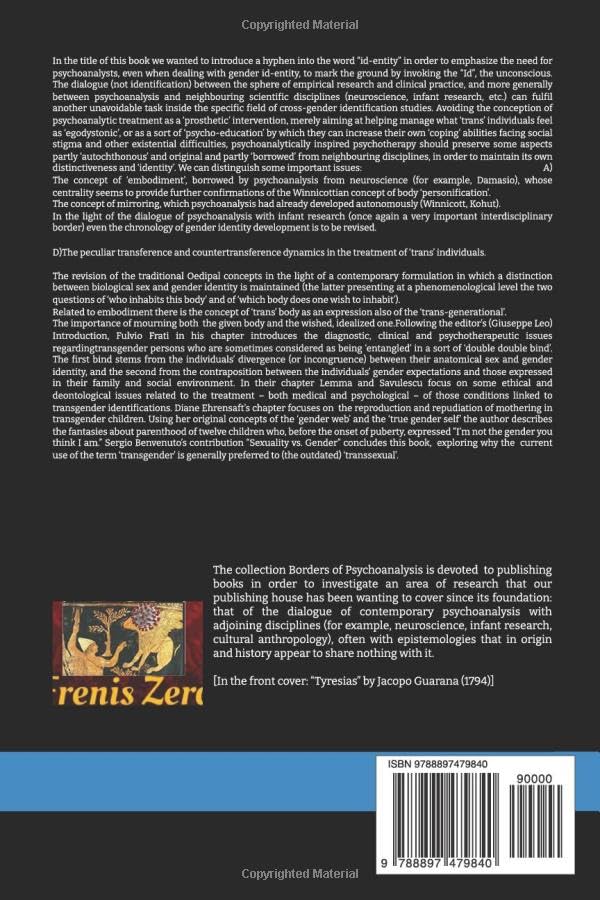
Details: In the title of this book we wanted to introduce a hyphen into the word “id-entity” in order to emphasize the need for psychoanalysts, even when dealing with gender id-entity, to mark the ground by invoking the “Id”, the unconscious. The dialogue (not identification) between the sphere of empirical research and clinical practice, and more generally between psychoanalysis and neighbouring scientific disciplines (neuroscience, infant research, etc.) can fulfil another unavoidable task inside the specific field of cross-gender identification studies. Avoiding the conception of psychoanalytic treatment as a ‘prosthetic’ intervention, merely aiming at helping manage what ‘trans’ individuals feel as ‘egodystonic’, or as a sort of ‘psycho-education’ by which they can increase their own ‘coping’ abilities facing social stigma and other existential difficulties, psychoanalytically inspired psychotherapy should preserve some aspects partly ‘autochthonous’ and original and partly ‘borrowed’ from neighbouring disciplines, in order to maintain its own distinctiveness and ‘identity’. We can distinguish some important issues: A) The concept of ‘embodiment’, borrowed by psychoanalysis from neuroscience (for example, Damasio), whose centrality seems to provide further confirmations of the Winnicottian concept of body ‘personification’. The concept of mirroring, which psychoanalysis had already developed autonomously (Winnicott, Kohut). In the light of the dialogue of psychoanalysis with infant research (once again a very important interdisciplinary border) even the chronology of gender identity development is to be revised. The peculiar transference and countertransference dynamics in the treatment of ‘trans’ individuals. The revision of the traditional Oedipal concepts in the light of a contemporary formulation in which a distinction between biological sex and gender identity is maintained (the latter presenting at a phenomenological level the two questions of ‘who inhabits this body’ and of ‘which body does one wish to inhabit’). Related to embodiment there is the concept of ‘trans’ body as an expression also of the ‘trans-generational’. The importance of mourning both the given body and the wished, idealized one. Following the editor’s (Giuseppe Leo) Introduction, Fulvio Frati in his chapter introduces the diagnostic, clinical and psychotherapeutic issues regarding transgender persons who are sometimes considered as being ‘entangled’ in a sort of ‘double double bind’. The first bind stems from the individuals’ divergence (or incongruence) between their anatomical sex and gender identity, and the second from the contraposition between the individuals’ gender expectations and those expressed in their family and social environment. In their chapter Lemma and Savulescu focus on some ethical and deontological issues related to the treatment – both medical and psychological – of those conditions linked to transgender identifications. Diane Ehrensaft’s chapter focuses on the reproduction and repudiation of mothering in transgender children. Using her original concepts of the ‘gender web’ and the ‘true gender self’ the author describes the fantasies about parenthood of twelve children who, before the onset of puberty, expressed “I’m not the gender you think I am.” Sergio Benvenuto’s contribution “Sexuality vs. Gender” concludes this book, exploring why the current use of the term ‘transgender’ is generally preferred to (the outdated) ‘transsexual’.
Share